


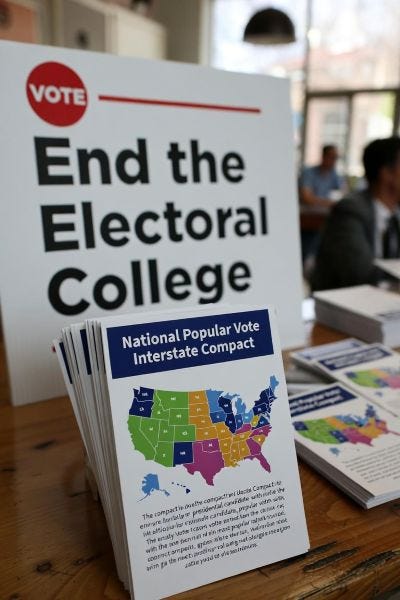
One of the most shocking outcomes of Tuesday’s mid term blue tidal wave was the Democrat Party taking complete control of the Governor’s mansion, State Houses and State Senates in Michigan, Minnesota, Nevada, Arizona, Pennsylvania and Wisconsin. These takeovers give the Democrats the opportunity to try to fundamentally change how Americans elect the President of the United States by implementing the National Popular Vote Interstate Compact (NPVIC). Here is what this means and where we stand.
How the President is Elected (the short, simplified version)
When Americans go to the polls on Election Day to vote for President of the United States, we actually vote for a slate of “electors” from the state in which we live. These electors are pledged to a particular set of Presidential and Vice Presidential candidates (though there are a number of examples of faithless electors, who cast their votes for someone other than the candidate to whom they were pledged). The number of electors is, in the language of Article II, Section 1, Clause 3 of the United States Constitution “. . . equal to the whole Number of Senators and Representatives to which the State may be entitled in the Congress . . ..”
Readers will recall, each State in the Union has 2 U.S. Senators, while each State’s number of representatives in the U.S. House of Representatives is apportioned based on population, with each State having at least 1 Representative. Thus, the number of electors afforded each State is the sum of each State’s Representatives, plus 2 for its Senators. My home State of Louisiana has 6 U.S Representatives and 2 Senators and, therefore, has 8 electors for purposes of electing the President of the United States.
The Presidency (and Vice Presidency) is determined by 50 separate, simultaneous State elections. The winning Presidential and Vice Presidential candidates of each State’s election then receives the State’s number of electors. The winning slate of electors then meet in the State capitol and formally cast their votes which are then certified and sent to the United States Senate. A Joint Session of Congress then meets and receives the certified State elector’s votes and the electoral votes are counted. The President/Vice President slate with a majority of 270 electoral votes is then certified as the President and Vice-President of the USA.
This process is known as the Electoral College.
Why This is Important
Instead of one nationwide election, our Country holds 50 State elections. In addition, the way the Electoral College votes are distributed actually gives less populous States greater influence on the outcome. This is because while each State’s number of electors is determined in part by population (by the number of House seats which are apportioned based on population), less populated States receive the same number of Senate seats (2) as heavily populated States.
This shifts the balance of power modestly in favor of less populated States. It also causes both Democrat and Republican Presidential candidates to focus on what are known as “swing States” (States which may be won by either Parties’ candidates) and to moderate their views to cater to voters in the swing States.
The Democrats (and some Republicans) Want to Alter This System
The National Popular Vote does not matter in an American Presidential Election. Stated another way, the Presidential and Vice Presidential slate receiving the most votes in the entire Country does not matter. What matters is who wins each State and, as a result, who wins the majority of votes in the Electoral College. While the President and Vice President who win the Electoral College USUALLY win the most votes in the Country (i.e., the National Popular Vote), there are notable exceptions.
The following candidates WON the National Popular Vote, but LOST the Electoral College:
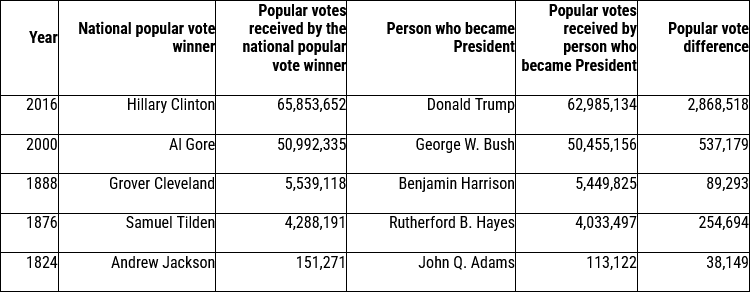
Readers will note, 2 of the last 4 Presidential wins by Republicans involved candidates who lost the National Popular Vote. In 2000, George W. Bush lost the popular vote to Al Gore and in 2016 Donald J. Trump lost the popular vote to Hillary Clinton. (In 2024, President Trump won the National Popular Vote by over 2 million votes.)
What is the National Popular Vote Interstate Compact?
The National Popular Vote Interstate Compact is a piece of legislation (bill) containing 888 words named by its drafters as the “Agreement Among the States to Election the President by National Popular Vote.” (A link to the text is here.) The proposed legislation reads, in part:

In short, this legislation would make the President and Vice President the slate of candidates who received the most votes nationwide (if enough States pass it).
The Agreement does not take effect until:

This is what changed in the recent mid term elections.
There are currently 538 electors. This is the combined amount of U.S. House members (435), plus US Senators (100), plus 3 electors for Washington, D.C., under the 23rd Amendment to the U.S. Constitution. 270 electors are needed to reach the majority.
At this moment, 18 states passed the National Popular Vote Interstate Compact, representing 222 electoral votes. This leaves the Compact 48 electors short of a majority.
By gaining complete control of the State governments in Michigan, Minnesota, Nevada, Arizona, Pennsylvania and Wisconsin, Democrats can now add 71 more electoral votes to the Compact and trigger the National Popular Vote Interstate Compact by reaching (and surpassing) 270 electoral votes.
All that is needed is for the States the Democrats just took control of to pass the Compact and add their electoral votes to the total: Michigan (15 electoral votes), Minnesota (10 electoral votes), Nevada (6 electoral votes), Arizona (11 electoral votes), Pennsylvania (19 electoral votes) and Wisconsin (10 electoral votes). The Compact would then take effect and fundamentally change how the President of the United States is elected.
Is The National Popular Vote Interstate Compact Enforceable?
If enough States pass the Compact to trigger its implementation (as Democrats now have the power to do), there will undoubtedly be litigation over the Compact’s validity. Whether it is enforceable or constitutional or not is open to debate. Here are some of the issues at play.
First, the Compact consists of legislation enacted by State Legislatures. Under the United States Constitution, the State Legislatures are empowered to determine how their electors are appointed. Article II, Section 1, Clause 3 of the United States Constitution provides, in part:

This is known as the “Electors Clause” or “Presidential Electors Clause.” The United States Supreme Court broadly interprets this clause as the “broadest power of determination” over each State’s electors. This principle was affirmed by the Supreme Court as recently as 2020 in Chiafalo v. Washington, a case involving State laws punishing “faithless electors.” The Court did note in Chiafalo, in footnote 4, that the State Legislature’s power to appoint electors is subject to the restrictions of the rest of the U.S. Constitution.
The Compact Clause
But, Article 1, Section 10, Clause 3 of the United States Constitution puts a check on “interstate compacts:”
No State shall, without the Consent of Congress . . . enter into any Agreement or Compact with another State . . .
This provision appears to bar interstate compacts unless Congress approves of them. The United States Supreme Court, however, limited the application of the Congressional Consent requirement to interstate compacts which tend to increase the political power in the States which may encroach upon or interfere with the just supremacy of the United States. Legal scholars are widely in disagreement over whether or not this Compact requires Congressional Consent under the Supreme Court’s precedent. But, if the federal courts determine this Compact does meet the Supreme Court’s test requiring Congressional Consent, then Congress must act and consent. What about that?
Presidential Veto?
The Democrats just won majorities in the United States House of Representatives and the United States Senate in the mid term election. Undoubtedly, the Democrat-controlled U.S. House and Senate will “consent” to the Compact if enough States pass it. The question then will be is that “consent” subject to a Presidential veto by President Donald J. Trump?
The answer is probably so. Congressional Consent is usually granted through legislation (a bill or joint resolution). Under the Presentment Clause of the U.S. Constitution (Article I, Section 7) every bill passing the U.S. House and Senate must be “presented” to the President who may object to it (we call this a “veto”) and return it to Congress which may then override his objections (veto) only by a two-thirds vote of both the House and Senate.
There is historical precedent for such a veto. For instance, in 1942, President Franklin D. Roosevelt vetoed the Congressional approval or consent of the interstate compact between Colorado, Kansas and Nebraska (known as the Republican River Compact).
Other Constitutional Issues
Legal scholars also widely disagree on the constitutionality of the National Popular Vote Interstate Compact. Professor Norman R. Williams, of the Williamette University School of Law, opined in a law review article in the BYU Law Review that the Compact is unconstitutional. Among other persuasive arguments he made is this:

Professor Daniel H. Lowenstein of the UCLA School of Law opines the Compact violates the Electors Clause by tethering the award of a State’s electors to something other than how the particular State decided the question. “If this requirement is not recognized, then there would be nothing to stop the legislature from designating the United Nations, the King of England or the Pope to name electors.”
Other legal scholars challenge the constitutionality of the NPVIC (see here and here), while some prominent legal scholars believe it is constitutional (see here and here).
Conclusion
The Democrat Party’s dramatic and decisive wins in last week’s mid term elections put the Party in a position to profoundly influence American legislation and policy, including providing it the ability to potentially change how Americans elect the President of the United States. The potential for additional States, now under complete control of the Democrat Party, to pass the National Popular Vote Interstate Compact and cause it to be implemented is real. In fact, the NPVIC is coming, whether voters were aware of it or not. Federal courts will need to determine its constitutionality and validity, but rest assured, the NPVIC is coming.