


Today, Fake News Exposed presents another article by Dr. Joseph Ford Cotto. Dr. Cotto is the creator, host and producer of News Sight, delivering sharp insights on the key events that shape our lives. He publishes Cotto’s Digest, sharing how business and the economy really impact us all. During the 2024 presidential race, he developed the Five-Point Forecast which accurately predicted Donald Trump’s national victory and correctly called every swing state. Cotto holds a doctorate in business administration and is a Lean Six Sigma Certified Black Belt.
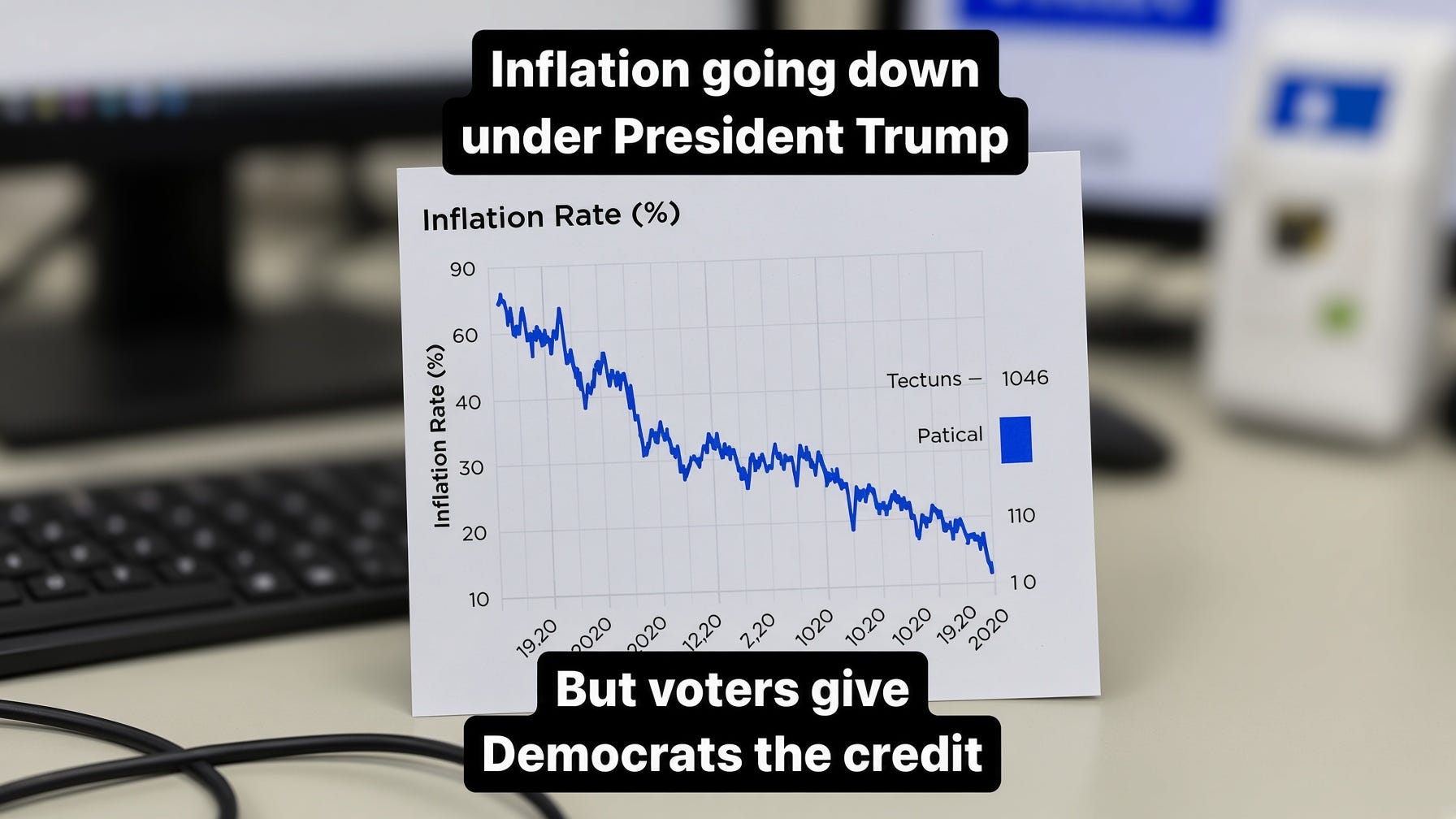
Voters Trust Democrats on Inflation, Even Though Trump Lowered It
If polls are to be believed, Americans are judging inflation by fading memory and tribal loyalty, not by the numbers.
That is how a plurality of likely voters can rate Democrats better than Republicans on the cost of living. Meanwhile, the last 20 months under President Donald J. Trump are plainly better than the first 20 months under President Joe Biden and Vice President Kamala Harris. The mismatch is not a rounding error. It is a GOP public-relations failure, which is maddening because the numbers are incontrovertible.
Start with mounting household bills.
Over the first 20 months of the Biden-Harris years, rising prices piled $7,081 in extra costs onto the average household. Over the matching span from January 2025 through August 2026, the extra burden was $4,200. That is $2,881 less; a 40.7 percent slowdown in the pace of added household pain:

Of course, prices did not fall. Inflation always means the checkout line costs more than it did beforehand.
Nonetheless, compared with the Biden-Harris surge, the Trump term cut the added hit by more than two-fifths. Every state posted a smaller increase.
Texas, a GOP-run state, saw the sharpest relief: household cost increases ran 58.4 percent lower, a $4,216 difference. New Jersey, a blue bastion, had the smallest slowdown at 18.2 percent. Even this was $1,243 less. Colorado, Utah, Nevada, Arizona, and Montana posted thousands of dollars less in added costs than they did in the Biden-Harris period. Even the Democratic behemoths of California and New York posted smaller increases relative to Biden-Harris.
Bureau of Labor Statistics consumer price data sit underneath those estimates. Democrats on the congressional Joint Economic Committee used the same basic method to crunch figures about Trump’s first term. Therefore, they cannot easily wave the new statistics away as mere partisan arithmetic.
This Polling Data is Real
Yet, a national survey of 1,500 likely voters offers a jarring revelation. I collaborated on this poll with the Democracy Institute’s Patrick Basham. It ran from September 21-23, finding Democrats ahead 46 percent to 42 percent on who would better control inflation. Blame for high prices splits 47 percent Trump and 47 percent Biden.
Asked whether Trump and Republicans have done their best on the economy, 51 percent say no and 44 percent say yes. A 53 percent to 43 percent majority says they would be more likely to vote Republican if everyday prices plummeted. Note this is a hypothetical, not a current generic ballot.
Basham does not direct a brand that churns out slop polling, which runs rampant nowadays. In November 2016, his Democracy Institute (DI) poll had Trump with enough support to beat Secretary of State Hillary Clinton. This came after the DI correctly called Brexit. Ten years ago, virtually no pollsters foretold Trump winning or Brexit passing. Indeed, the DI is the only firm to accurately forecast both events.
In 2024, the final DI/Daily Express pre-election poll showed Trump up by three points over Harris. The exit poll had Trump leading as well. He went on to win the popular vote; the first time any Republican did so in 20 years. When a pollster with that record finds Democrats rated better on inflation, the problem is not the questionnaire. The problem is that too many voters have not been told the comparison in language that resonates.
Any inflation still lifts prices. Families feel the pinch of every penny. The charge is not that living costs under Trump are pleasant. The charge is that Biden-Harris inflation was worse and that the second Trump term cut the added household hit by more than two-fifths. For a plurality to give Democrats the edge on inflation is absurd. It is also a harsh verdict on whatever passes for the Republican public affairs strategy.
GOP messaging has failed to make the contrast felt. Republican politicians and politicos recite indexes. Voters remember steak and insurance. The party has not hammered that the record now shows a $2,881 smaller burden under Trump, in every state, with Texas nearly 60 percent better. Until that sentence is repeated, then made relevant to the costs of essential goods and services, Democrats will keep winning the inflation argument. Even though they lost it on paper.
This is ugly news for the GOP brand, way beyond November. Economic reputation travels into 2028. A presidential primary field will inherit whatever the public believes about prices. If the belief is that Republicans are the pro-inflation party, then the next nominee starts in a hole no slogan can fill. The DI poll does not show a collapsed coalition. It shows a solid base without a national majority, or even a plurality, on economic management. That is no catastrophe, but it is an unsettling warning.
It is also not just cause for midterm doom and gloom. I built the Five-Point Forecast that called Trump’s 2024 national and swing-state wins: economic sentiment and inflation, felt jobs and growth, energy prices and confidence, judgment of Washington’s economic response, and trusted polling. Those points moved a presidential electorate.
Midterms are a different crowd. Presidential years since 1980 have averaged about 63 percent turnout among voting-age citizens. Midterms average about 48 percent. The drop leaves an older, more crystallized, overwhelmingly tribal pool of partisans. Especially in this age of escalating political polarization.
Recent data confirm the point.
About 68 percent of 2020 presidential voters came back in 2022. Trump 2020 voters returned at 71 percent, and Biden voters at 67 percent. Dual-cycle voters barely switched: 95 percent of 2018 Republicans and 92 percent of 2018 Democrats remained loyal. Issue gaps have widened 64 percent since 1988, almost all after 2008. The left moved 31.5 percent more socially liberal on abortion, family, equality, insurance, and race. The right moved only 2.8 percent more conservative.
Mixed views thinned, because people now vote as blocs.
History has slayed the notion that economics write the midterm script. A tight labor market and a major tax cut still cost U.S. House Republicans about 30 seats in 2018. Forty-year-high inflation in 2022 still produced the strongest midterm showing in two decades for an incumbent president’s party. Democrats held the Senate, and almost kept the House, simply because their voters showed up where it counted most.
The president’s party has lost an average of 25 House seats in midterms since 1946, and nearly 37 when approval sits under 50 percent. No economic theory erases that penalty.
November brings hundreds of House, Senate, state, and local fights. A handful of suburban legislative districts can counteract finely-crafted talking points, generated by well-paid consultants in DC. Partisan organization, and organic voter motivation, beat social media vibes. The movable middle barely exists, especially this year. Midterms belong to tribes, not an economics-first electorate.
That does not excuse the inflation gap in public opinion. Public ignorance is real and rueful. Americans just lived through a 40.7-percent slowdown in added household costs. A plurality of them nonetheless awarded the inflation-control trophy to the Democrats, who presided over sheer carnage. Shame on the voters who refuse to look at the facts. Greater shame on the Republicans who will not put those facts in front of Americans every day, in a manner which normal people can understand.
Prices still rose under President Trump. However, compared with Biden-Harris, the rise was slower and more manageable for families in all 50 states. That should be the first sentence of Republican economic talk from now through 2028. The party has every reason to get real about its record. If it fails to do so, then Republicans should hardly be surprised when the next presidential race treats inflation control as a winning issue for Democrats.
Considering what the blue team actually did, that would be inexplicable.
(Be sure to give Dr. Cotto a follow on his social media account at X where you will find his podcast episodes, links to his books and articles, along with his daily posts containing everything from political analysis to economic analysis and more.)