


Federal law has long told an otherwise eligible buyer that he may purchase a handgun from a licensed dealer in another state - so long as he does not take it home. Instead, the gun dealer must send the handgun to a second dealer in the buyer’s home state, pay a transfer fee, and wait. Call it a “condition of sale.” What it does is ban direct purchases of handguns out of state.
On September 18, 2026, a divided panel of the United States Court of Appeals for the Fifth Circuit held the federal barrier unconstitutional under the Second Amendment. The ordinary question is simple: when does a commercial “condition” become a purchase ban the Constitution still reaches?
The case is Elite Precision Customs, L.L.C. v. BATFE. The district court’s opinion includes a very informative, concise background paragraph explaining the basic law, the parties and what the case is about:
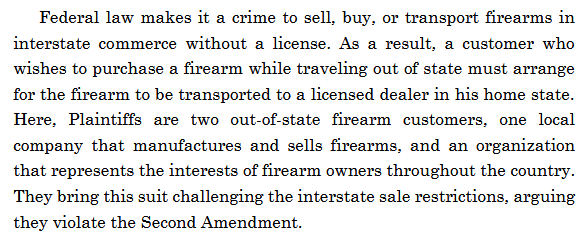
Plaintiffs included Elite Precision Customs, a Texas licensed dealer that said it would sell handguns directly to nonresidents but for the Ban; Arizona resident Freddie Blish and New Mexico resident Tim Herron; and the Firearms Policy Coalition. Herron attested that the home-state dealer workaround typically cost him $30 to $40 and delayed possession. The district court held the Ban did not implicate the Second Amendment’s plain text. The U.S. Fifth Circuit disagreed.
The case involved challenges to three separate provisions of Federal criminal law. These three statutes, acting together, create the challenged framework.
First, 18 U.S.C. 922(a)(3) generally bars a person from transporting a firearm into the State where he resides if the firearm was “purchased or otherwise obtained” outside of the State.
Second, 18 U.S.C. 922(a)(5) generally bars a person from transferring a firearm to a person who resides in another State and
Third, 18 U.S.C. 922(b)(3) bars licensed dealers from selling firearms to a person who the dealer knows or should know does not reside in the State where the dealer is located.
Two of the three judges on the U.S. Fifth Circuit panel which considered the case found the ban on interstate handgun purchases unconstitutional under the United States Supreme Court’s landmark Second Amendment case New York Rifle & Pistol Ass'n v. Bruen.
The Right to Keep and Bear Arms Necessarily Includes the Right to Buy Arms
The Supreme Court’s decision in Bruen set forth a straight-forward two step process for the successfully challenge of a firearms regulation:
First, the plaintiff (the party challenging the firearms law or regulation) must show that the plain text of the Second Amendment covers the banned or proscribed conduct. Second, if the court finds the Second Amendment covers the conduct, then the government must demonstrate the law or regulation is “consistent with the Nation’s historical tradition of firearm regulation.”
At Bruen Step 1, the Fifth Circuit majority followed the Fifth Circuit’s earlier holding in Reese v. ATF: the right to keep and bear arms “surely implies the right to purchase them.” A categorical bar on an entire class of otherwise lawful handgun purchases is a purchase ban, not a mere market stipulation.
The government leaned on the home-state FFL transfer and on McRorey v. Garland, which upheld an expanded background-check waiting period with a defined end. The Fifth Circuit majority treated those as different animals. A ten-business-day delay ends by operation of law. The Ban never does. The workaround also depends on a receiving dealer’s willingness and adds a fee. Once plaintiffs show the law restricts keeping or bearing arms for “the people,” it is presumptively unconstitutional.
The Government’s Historical Analogues - and Why They Failed
At Step 2, the government offered eighteen colonial and early-republic laws. The majority grouped them into wartime and common-defense measures, regulation of commerce with foreign sovereigns (including Indian tribes and, early on, other colonies), and consumer-protection prototypes such as inspection and quality control. A Dutch-era New York restriction whose full text has been lost was discounted.
None matched the modern Ban’s “why” and “how:” peacetime public-safety regulation of lawful interstate handgun sales among residents of states within one sovereign. Citing United States v. Hemani (a 2024 case in which SCOTUS held the prohibition on possession of firearms by an unlawful user of controlled substances violated the 2A) the Fifth Circuit refused to stretch colonial border controls into a founding-era tradition for today’s rule.
There is Now a Circuit Split
The U.S. Fifth Circuit Court of Appeals held the ban on interstate handgun purchases unconstitutional. The United States Court of Appeals for the Second Circuit held these same provisions of Federal law to be constitutional in a decision rendered in 2025 called United States v. Vereen. This is an important fact implicating the United States Supreme Court’s discretionary review. United States Supreme Court Rule 10 specifically identifies a “split” in the circuit court decisions as a primary grounds for the Supreme Court to take a case:

This split in the circuit courts of appeal on this question of law make the Supreme Court’s intervention more likely, as media recognizes:

What the Ruling Does Not Wipe Out
Precision matters. The court did not strike background checks, prohibited-person rules, or state possession and purchase requirements. It addressed the federal prohibition on direct interstate handgun purchases formed by these § 922 provisions. As The Firearm Blog observed, ATF dealer guidance has not instantly rewritten itself.
The strongest serious objection is the government’s public-safety story: people might shop across borders to evade stricter home-state rules. That concern is real as policy. Under Bruen, policy fears do not substitute for a historical tradition the government must prove. Tools aimed at prohibited persons and genuine evasion must fit the constitutional method the Supreme Court prescribed - not a peacetime categorical ban dressed up as a commercial condition.
The Practical Stakes for Lawful Buyers
For lawful buyers within the Fifth Circuit’s orbit (Louisiana, Texas and Mississippi), the judgment means this Federal ban failed constitutional review. The decision is not yet final, as the government may apply for rehearing (ask the Fifth Circuit panel to take another look at the case) or for rehearing en banc (ask the entire US Fifth Circuit Court of Appeals to review the case). For now, even in Louisiana, Texas and Mississippi nothing will change immediately. But, a lot of eyes are on the case watching to see what happens next.
Conclusion
The Second Amendment’s guarantee of the Right to Bear Arms does not mean much if the government can stop its citizens from buying firearms. When the government forbids an entire class of direct, otherwise lawful handgun sales without a founding-era tradition for that peacetime barrier, calling the rule a "condition of sale" does not save it. Further, given the federal background check system which weeds out ineligible purchasers, there is little justification for the prohibition. The Fifth Circuit got it right. Now we will see if the ruling sticks.