

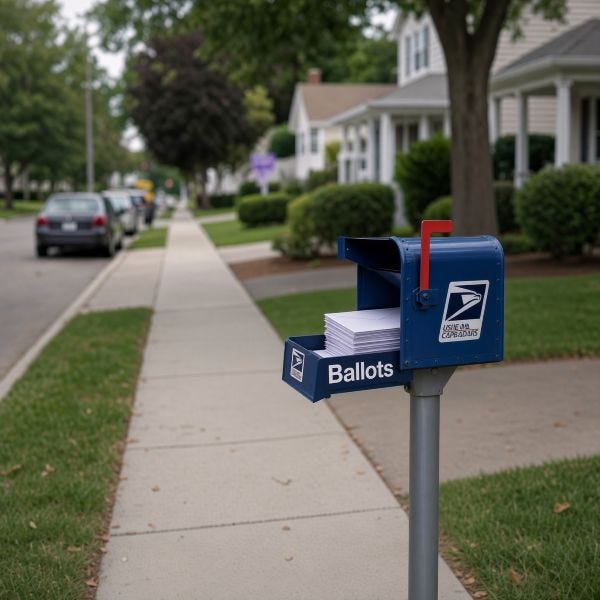
My article last Tuesday, August 25, 2026, dealt with the United States Supreme Court’s decision granting the Trump Administration's request for a stay of a Massachusetts federal judge’s order enjoining (preventing enforcement of) President Trump’s Executive Order dealing with the United States Postal Service and mail-in ballots (among other things). The SCOTUS decision allowed the Executive Order to be enforced while the case works its way through the appeals process.
When the case reached the Supreme Court, the USPS was yet to issue any actual regulations in furtherance of the Executive Order. As I noted in the article on August 25, 2026, the United States Postal Service issued the regulations implementing parts of the Executive Order on August 21, 2026, with the regulations going into effect on August 26, 2026. The same judge the Supreme Court just reversed now entered another injunction the following day, August 27, 2026, this time, against the regulations and not the Executive Order.
Judge Indira Talwani Strikes Again
U.S. District Judge Indira Talwani (nominated by former President Obama), tried to stop the United States Postal Service and the United States Attorney General from doing what President Trump instructed them to do in the Executive Order. She suffered a stinging rebuke from the United States Supreme Court in its August 24, 2026 decision, as I described at length in my August 25, 2026, article.
The primary problem with her previous rulings is the court had no jurisdiction to stop the federal government from implementing the Executive Order, because there was no “case or controversy” (which is required by Article III of the United States Constitution), since the plaintiffs in the cases suffered no harm (and as a result had no “standing’). There were other problems with the lower court’s decisions, but this one proved fatal across the board.
The Supreme Court’s decision on August 24, 2026, however, did NOT approve any USPS regulations implementing the President’s Executive Order, because those regulations were not in force yet.
I stated in my August 25, 2026, article:
Contrary to the claims made widely on social media today, the Supreme Court’s decision did NOT address these regulations, their validity or legality. That fight is coming. You can bet the Obama-nominated judge who shot down the Executive Order before any regulations were even issued will find the regulations illegal, unconstitutional or otherwise unenforceable. But, that won’t be the last word.
I don’t think a prognostication of mine was ever proved correct any quicker than this one. On August 27, 2026, the day after the USPS regulations at issue went into effect, this same judge granted a temporary restraining order stopping enforcement of the new regulations for fourteen (14) days. (A temporary restraining order or TRO is a type of injunction that instructs a person to stop taking a particular action or actions. It is limited to 14 days under FRCP 65, but can be extended another 14 days).
My Next Predictions
The Federal Rules of Civil Procedure provide a short timeline for injunctions. Temporary Restraining Orders last 14 days and may be extended another 14 days. Thereafter, the TRO is supposed to be dissolved or a Preliminary Injunction is to be issued. Mark my words, this federal judge will extend this TRO by another 14 days and/or grant a Preliminary Injunction against the regulations. How could I know? She already told the world as much in the rulings reversed by the Supreme Court. The judge’s latest ruling is more of the same.
The judge’s order granting the TRO contains the following language:

To issue a TRO, the court had to find the parties challenging the USPS regulations are “likely to succeed on the merits” (among other things). This judge thinks the USPS “likely” lacked authority to issue the Final Rule and that the regulations are “likely” unconstitutional.
The judge is “likely” wrong about all of the above. The higher courts will need to address this, but the tight timelines between now and the November elections will make it difficult for the regulations to be enforced for the mid terms.
The judge had this to say in response to the Government’s contentions about the need for the regulations:

Mail ballot fraud is an “unsubstantiated problem?” That is a ridiculous statement for a person with a lifetime appointment to the federal judiciary to put in writing. How ignorant of reality would one have to be to make such an statement in a court order? Unbelievable. Mail ballots are highly susceptible to fraud. The bipartisan commission on federal election reform, formed in the aftermath of the 2000 U.S. Presidential Election, found mail voting and absentee voting found “Absentee ballots remain the largest source of potential voting fraud” and that was over 20 years ago. But this is an “unsubstantiated problem?”
The North Carolina Curveball
North Carolina is a party plaintiff in the California v. Trump case (one of the two cases before Judge Talwani). That means it is one of the states challenging the Executive Order and USPS regulations in federal court.
Guess what? On August 27, 2026, the North Carolina Board of Elections confirmed it (1) submitted envelopes to the USPS for review and approval and (2) uploaded a list of everyone to whom the state is submitting a ballot:

The NC Board of Elections issued a public statement confirming it expects the state’s plan to send out absentee ballots “will happen flawlessly and smoothly.”
The State of North Carolina complied with the USPS regulations on the very same day the federal judge issued her Order finding “Plaintiff states” (which includes North Carolina, of all things) do not have the “time or funds” to comply with the regulations.
How could North Carolina comply with the regulations you might ask? Because the United States Postal Service already has standards in place for the design of US mail pieces (the USPS even employs “Mailpiece Design Analysts” for this very purpose) and already recommended the changes made by the regulations in the USPS Official Election Mail Guide.
Despite this, the plaintiff states go to federal court and screech about being unable to comply with simple requirements from the USPS about ballot envelopes and voter lists when some of the same plaintiff states already implemented the recommended changes and the others should have. Further, are we to believe these states cannot compile lists of the voters to whom ballots are to be mailed? They undoubtedly have lists of the names and addresses of the voters to whom ballots are being mailed, otherwise the ballots could not be mailed in the first place.
The fact one of the states suing the USPS over the regulations is able to comply with the regulations in a timely manner SHOULD work in favor of the USPS and the regulations, since the ability to comply completely undermines the claims such compliance is impossible. Judge Talwani will undoubtedly be unpersuaded by evidence of North Carolina’s compliance, but higher courts might.
Additionally, other states are purportedly going to comply with the regulations in coming days. That will greatly undermine the claims by the states who sued the government that they are unable to comply.
Conclusion
The federal district judge in Massachusetts did exactly and precisely what every conservative legal commentator following this case expected her to do. Her opinions in this case read like they were drafted by lawyers for the Democrat National Committee, so reading the “tea leaves” and making an educated guess about how she would rule was not difficult. The Government’s request for a stay of the TRO is already filed. (A stay of the TRO would allow the regulations to be implemented.) That stay will be denied. Then she will extend the TRO by another 14 days or grant a preliminary injunction or both.
The Trump Administration will need to get relief from the Court of Appeal or Supreme Court, as is so often the case. I doubt that can all be done in time to salvage these simple regulations in time for the mid-term elections in November. We will see. Keep in mind the current regulations do very little to improve election integrity. There will likely be more regulations promulgated before 2028. Again, time will tell. I will do my best to keep you all informed.
Thanks for the articles on this and others. It really helps put things into perspective. Keep up the good work on all the articles you write including all the wins the administration has had in courts. Jeff Childers compiled a list of all the accomplishments Trump 2.0 has achieved. Could you create a list of all the suits brought against the administration by the Dems and others and the wins/losses? I do not believe that these cases are getting enough attention and how Trump 2.0 is accomplishing things despite all the lawfare being waged against it. I also saw President Trump truth social post regarding Missouri's Supreme Court ruling and confused about that. However, I think one positive thing coming out is that people are starting to pay attention of all the shenanigans going on.