

The federal government has a peculiar relationship with the states when it comes to elections.
Federal law makes it illegal for noncitizens to vote in federal elections. (See 18 U.S.C. 611.) Federal law also requires states to maintain accurate voter-registration lists. (See 52 U.S.C. 20507(a)(2)-(5).) Yet, when states seek information from the federal government to determine whether people on their voter rolls are citizens, they can find themselves accused of violating the voters’ privacy rights.
That apparent contradiction is now before the Supreme Court.
On September 8, the Trump administration asked the Supreme Court to allow the Department of Homeland Security to resume operation of an expanded version of its Systematic Alien Verification for Entitlements program, commonly known as SAVE. The application follows a September 4 decision by the U.S. Court of Appeals for the D.C. Circuit refusing to stay a lower-court ruling that blocked the expanded system while the case is on appeal. (See here, Department of Homeland Security v. League of Women Voters.)
The dispute is worth understanding because underneath the partisan arguments lies a fairly straightforward question: What information may the federal government provide to state officials charged with determining who is legally eligible to vote?
What SAVE Actually Does
SAVE is not new. Congress created the underlying verification system in 1986 so government agencies could verify immigration status when determining eligibility for certain public benefits. For decades, federal, state and local agencies have used it for government eligibility determinations.
The system was substantially expanded in 2025.
Previously, SAVE generally searched DHS immigration records, usually one person at a time. That meant it had an obvious limitation: DHS might have extensive information about immigrants and naturalized citizens while having little useful information about Americans who were citizens from birth.
The modified system connects SAVE with Social Security Administration records, permits searches using Social Security numbers and allows bulk searches. A state election agency can submit identifying information and receive citizenship or immigration-status information through SAVE.
That made the database considerably more useful for voter-list maintenance—and considerably more controversial.
The League of Women Voters, the Electronic Privacy Information Center and several individual voters sued. In June, U.S. District Judge Sparkle Sooknanan ruled against the government, concluding, among other things, that the modified system violated the Social Security Act and Privacy Act and that DHS lacked statutory authority for the changes. (D.C. Circuit Court)
The government appealed.
The (Misunderstood) SSN Privacy Question
Many Americans believe federal law prohibits the use of Social Security Numbers (SSN) for identification. This is simply not the case. Federal law actually provides limited confidentiality for SSNs.
The Social Security Act protects Social Security numbers and certain related records from disclosure, under some circumstances. The plaintiffs in the SAVE database case argue that the expanded SAVE system improperly transfers protected information from the Social Security Administration to DHS and then makes information available to requesting government agencies.
The government contends the confidentiality provision regarding SSNs is not applicable at all.
The Social Security Act provides the following with respect to the confidentiality of SSN:

(42 U.S.C. 405(c)(2)(C)(viii)(I).) This is the basic SSN confidentiality provision. Readers will note, it protects SSNs “obtained or maintained” by the government “pursuant to any provision of law enacted on or after October 1, 1990” from disclosure.
In its Application for a Stay filed with SCOTUS, the Trump Administration points out:
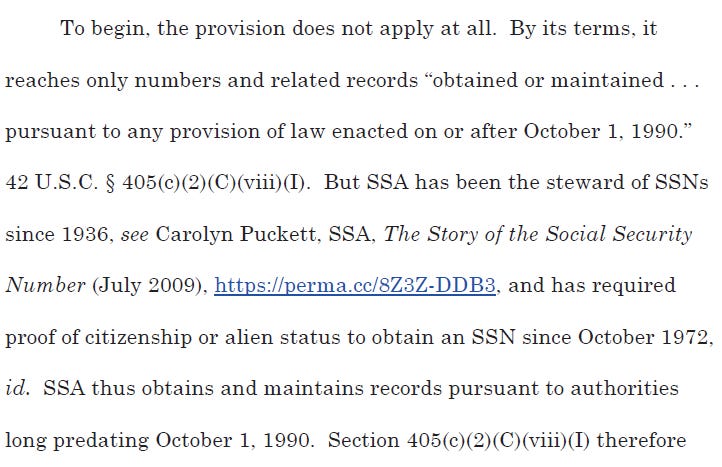
The federal government further points out, the SAVE system actually started in 1986, in response to the income and eligibility verification systems required by 42 U.S.C. 1320b-7. As a result, the SAVE system predates 1990 as well (thereby not violating the SSN confidentiality provision).
Additionally, federal statutory law requires the federal government to provide states with information regarding the citizenship or immigration status of an individual. (See 8 U.S.C. 1373.)
Finally, the government notes the way the SAVE system is being used does not violate the confidentiality provision even if the court found it applied. This is because the way the system is set up, the DHS is NOT sharing SSNs. The States requesting the SAVE eligibility search provide the SSN (or the last four digits of it) to the Department of Homeland Security.
The Dissenting Judge in the DC Circuit Highlighted These Issues
The Trump Administration appealed the
Judge Gregory Katsas, dissenting from the D.C. Circuit’s refusal to stay the lower-court ruling, offered an important distinction.
He concluded that the Social Security Act provision relied upon by the plaintiffs does not prohibit SSA from supplying the relevant information to DHS because SSA maintains its core Social Security and citizenship records pursuant to statutes predating the particular 1990 confidentiality provision at issue.
More importantly, Katsas said DHS does not disclose Social Security numbers obtained from SSA to the requesting election agency. Instead, it provides information concerning citizenship or immigration status about a person whom the requesting government agency has already identified. (D.C. Circuit Court)
That distinction deserves considerably more attention than it has received.
There is an obvious difference between publishing citizens’ Social Security numbers or personal records and one government agency asking another government agency: Is this identified person a citizen?
Whether the statutes legally permit that exchange is precisely what the courts must decide. This precise information is exchanged for a number of other reasons (see 8 U.S.C. 1373, and 8 U.S.C. 1644, for instance). Additionally, the SAVE system has been used for voter eligibility verification since 2005 (to a lesser extent). The answer seems obvious, but thus far, the federal courts do not agree.
But What About Mistakes?
The challengers raise another legitimate concern: government databases contain errors. How will these errors affect voters?
Two U.S. citizens involved in the litigation say Social Security records still identify them as noncitizens because they obtained Social Security numbers before becoming naturalized. Federal agencies themselves acknowledged that citizenship data maintained for Social Security purposes may not always be current when used for another purpose. (D.C. Circuit Court)
That is a potential problem.
But it does not necessarily follow that states should therefore be denied access to federal citizenship information altogether. After all if a person’s citizenship is not confirmed by the SAVE system (which includes a manual search of records if the database search does not confirm citizenship) the State is directed to “contact the registrant or registered voter to obtain proof of U.S. citizenship.” Providing such proof by a person who is a naturalized U.S. citizen would be incredibly simple.
A database match—or failure to match—does NOT automatically cancel anyone’s voter registration. It can instead trigger additional verification and provide the affected voter an opportunity to establish citizenship and correct erroneous government records.
The sensible legal question is therefore not whether government databases are infallible. Obviously they are not.
The question is whether inaccuracies require abandoning citizenship verification or instead require adequate procedures for correcting mistakes. The federal government notes in its Application for a Stay filed with the United States Supreme Court that from January 1, 2026 to April 1, 2026, SAVE processed 59.7 million voter-verification queries from elections officials in 27 States. The tiny number of errors identified by the plaintiffs highlights the exceedingly low error rate of the system. And how hard it is it for a naturalized citizen to prove he or she is naturalized? Not very hard at all, since each naturalized citizen gets a Certificate of Naturalization.
Additional Considerations
Judge Katsas’s dissent in the D.C. Circuit’s order denying the government’s Application for a Stay of the lower court ruling identifies the issue that may ultimately attract the Supreme Court’s attention.
Federal law requires states to maintain accurate voter-registration rolls. Federal law also prohibits noncitizens from voting in federal elections. And the Constitution leaves substantial responsibility for administering elections with the states.
Yet immigration and citizenship records are overwhelmingly controlled by the federal government.
As Katsas put it, how are states supposed to perform their responsibilities effectively if they cannot obtain reliable citizenship and immigration information from the federal government—the government with primary authority over immigration? (D.C. Circuit Court)
Congress has also directed DHS to respond to government inquiries seeking information about the “citizenship or immigration status” of individuals within their jurisdictions under 8 U.S.C. §1373(c). (D.C. Circuit Court)
That creates the central tension in the case.
Congress protects personal information. Congress requires accurate voter rolls. Congress prohibits noncitizen voting. Congress also requires the federal government to provide certain citizenship and immigration information to government agencies.
The courts have to interpret those provisions together.
(There is more to the case, including Privacy Act and Administrative Procedure Act issues, however, the SSN issues predominate and this article focused on those issues.)
CONFLICTING RULINGS
This article focused thus far on the district court ruling in the D.C. District blocking the use of the database. Another federal district court in Florida ordered the federal government to allow four states involving in litigation before the court in Florida to continue accessing the SAVE database:

The case was the subject of a settlement agreement between the federal government and four states in 2025. The terms of the settlement called for the four states involved to be able to access SAVE. When the district court in DC enjoined the use of SAVE, the federal government quit performing the SAVE verification for the four states. The states then went back to the federal district court in Florida and the court ordered the SAVE searches to resume.
The federal judge in the Florida case observed:

The decision is an interesting read. Check it out here. (Judge Sooknanan is the federal judge in DC who ordered the SAVE searches must stop. She was born in Trinidad and Tobago and was one of 22 judges nominated by former President Biden, but confirmed by the U.S. Senate after President Trump won the 2024 Presidential election. Her bio page at the DC District, includes a link describing how to pronounce her name.)
Now the Supreme Court Has the Question, Maybe
The procedural posture matters, since SCOTUS may not decide to weigh in on the issues just yet.
The D.C. Circuit has not yet issued a final decision on the government’s appeal. On September 4, 2026, a divided panel refused to suspend the district court’s ruling while that appeal proceeds. The majority emphasized that some of the government’s present Social Security Act arguments had not been properly presented earlier in the litigation. Judge Katsas would have granted the stay. (D.C. Circuit Court)
The Trump administration then went to the Supreme Court and requested a Stay. The case is Department of Homeland Security v. League of Women Voters, No. 26A308. The government filed its Emergency Application for a Stay on September 8, 2026. The challengers filed their opposition September 15. (Supreme Court.)
The immediate question before the justices is not yet the ultimate winner of the case. It is whether SAVE may operate while the underlying litigation continues. But the larger issue will remain regardless of how the High Court handles the emergency application.
Election officials have a legitimate obligation to protect eligible citizens from being improperly removed from voter rolls.
They also have a legitimate obligation to ensure that people who are not eligible to vote do not remain registered.
Those obligations are not mutually exclusive.
CONCLUSION
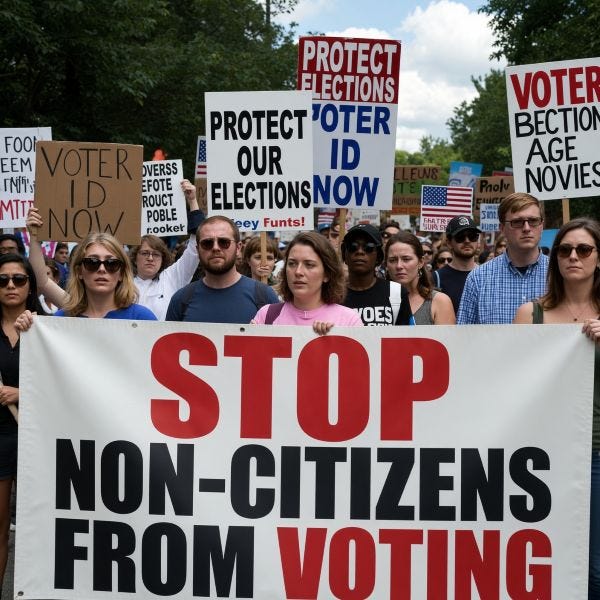
The vast overwhelming majority of Americans want non-citizens to be removed from voter rolls, prohibited from registering to vote and prohibited from voting. The far left disagrees and opposes any efforts to stop non-citizens from registering to vote, to remove non-citizens from voter rolls or to stop them from voting. Whether Americans will win this fight remains to be seen, but in the short-term without intervention from the United States Supreme Court, election integrity will take the loss.